Publications
REPORTS AND PUBLICATION
Welcome to KAWUO’s Publications page. Here you can access annual reports, semi-annual reports, strategic plans, policy briefs, newsletters, and other organizational publications.
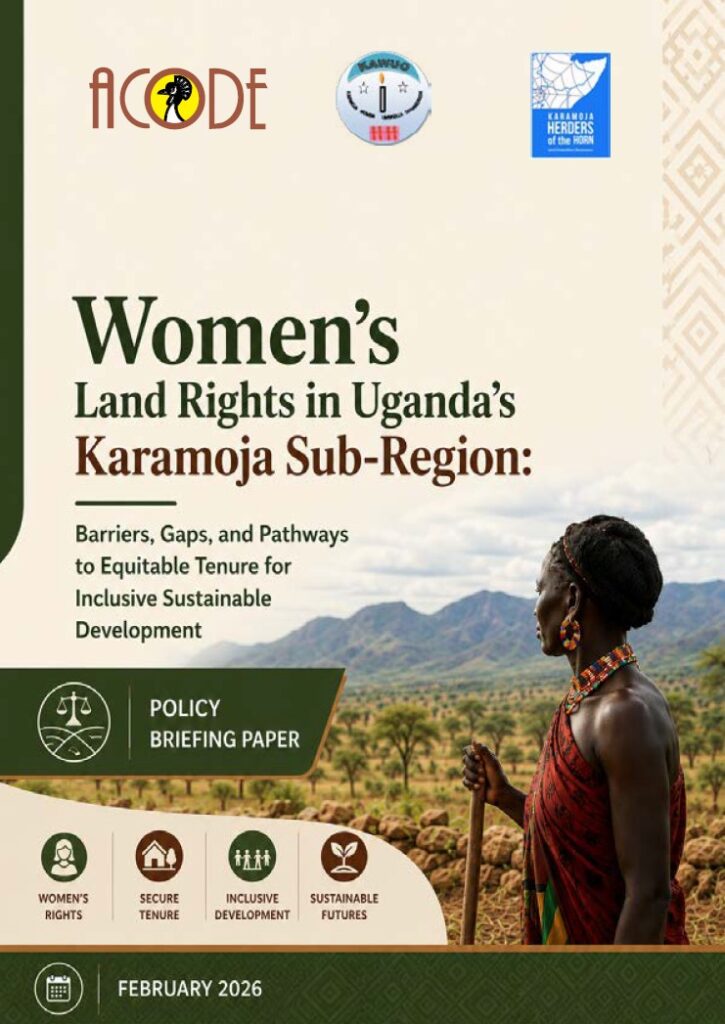
WOMEN'S LAND RIGHTS IN KARAMOJA REGION, UGANDA
The Women’s Land Rights in Karamoja Region, Uganda publication examines the status of women’s access to, ownership of, and control over land within the Karamoja sub-region. It explores the legal, cultural, and socio-economic factors that influence women’s land rights, highlighting the challenges they face in securing land tenure and participating in land governance and decision-making processes.
The publication presents key findings, evidence-based analysis, and practical recommendations to strengthen gender-responsive land policies, promote equitable access to land and natural resources, and protect the land rights of women and girls. It serves as an important resource for policymakers, local governments, cultural leaders, civil society organizations, development partners, and communities working to advance gender equality, women’s economic empowerment, and sustainable development in Karamoja.
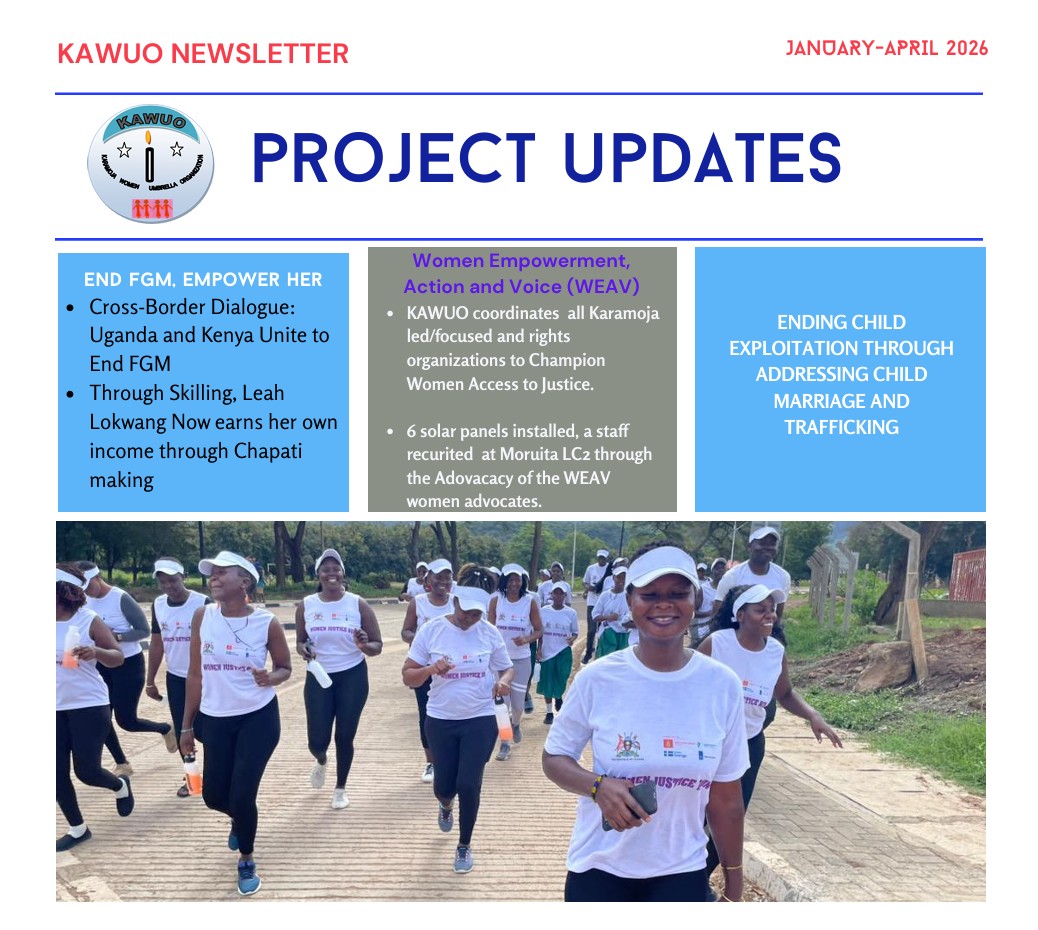
KAWUO Semi-Annual Report January – June 2026
Project Updates provides an overview of the key achievements, milestones, and impact of KAWUO’s programmes during the reporting period of January–April 2026. The organization continued implementing interventions aimed at empowering women and girls, promoting gender equality, protecting children’s rights, and strengthening community resilience across the Karamoja sub-region.
During this period, KAWUO made significant progress in ending Female Genital Mutilation (FGM) through cross-border dialogue between Uganda and Kenya, supporting women’s economic empowerment through vocational skills and income-generating activities, and advancing women’s access to justice under the Women Empowerment, Action and Voice (WEAV) programme. Community advocacy also contributed to the installation of solar panels and strengthened local leadership participation in promoting women’s rights.
In addition, KAWUO intensified efforts to address child exploitation, child marriage, and human trafficking through awareness campaigns, stakeholder engagement, and community-based protection initiatives. These achievements demonstrate KAWUO’s commitment to creating safe, inclusive, and empowered communities while improving the lives of women, girls, and vulnerable populations in Karamoja.
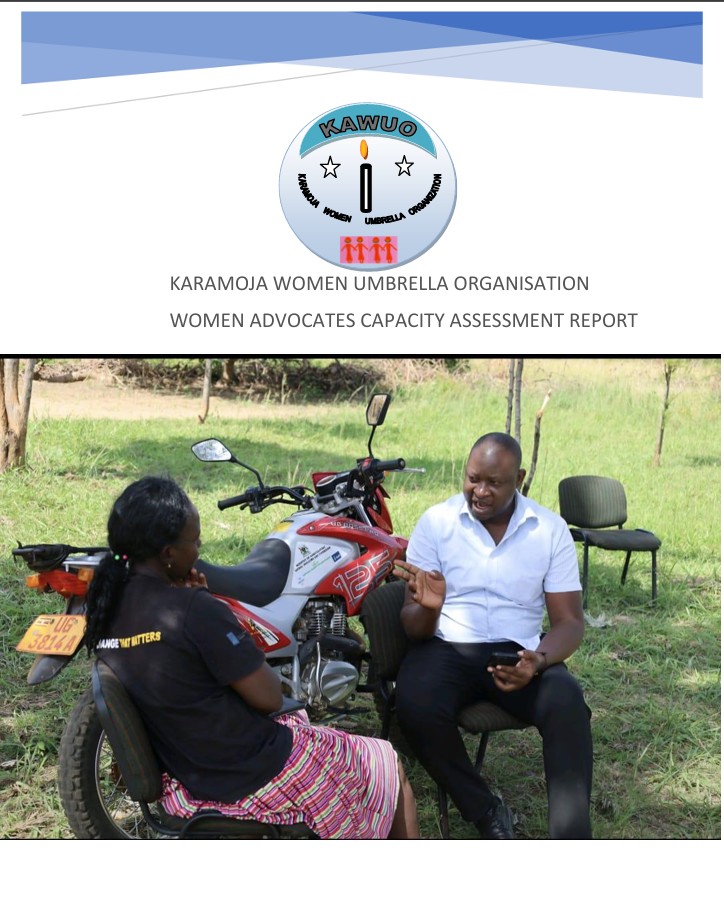
ADVOCAY OF CAPACITY ASSESSMENT REPORT
KAWUO conducted a capacity assessment of 100 women advocates across five WEAV project
districts (Abim, Kaabong, Moroto, Nakapiripirit, and Napak) to determine their knowledge,
confidence, leadership, and participation in local governance and influence to public decision
making. The respondents were drawn from 22 sub-counties, town councils, and divisions,
providing broad geographical representation. The assessment found that women advocates possess
a strong educational foundation, with 92% having attained formal education, including 46% with
secondary education and 12% with tertiary education.
Overall, the findings demonstrate that the project has significantly strengthened women’s
knowledge, confidence, and participation in governance processes. The majority of respondents
demonstrated good knowledge of women’s rights (91%), gender-based violence (GBV) reporting
pathways (97%), local government leadership roles (91%), community decision-making processes
(78%), and government programmes targeting women (78%). Women advocates correctly
identified key rights relating to participation in decision-making, property ownership and
inheritance, access to education, and freedom from all forms of gender-based violence. They also
demonstrated a clear understanding of GBV referral pathways and local government planning and
budgeting processes.
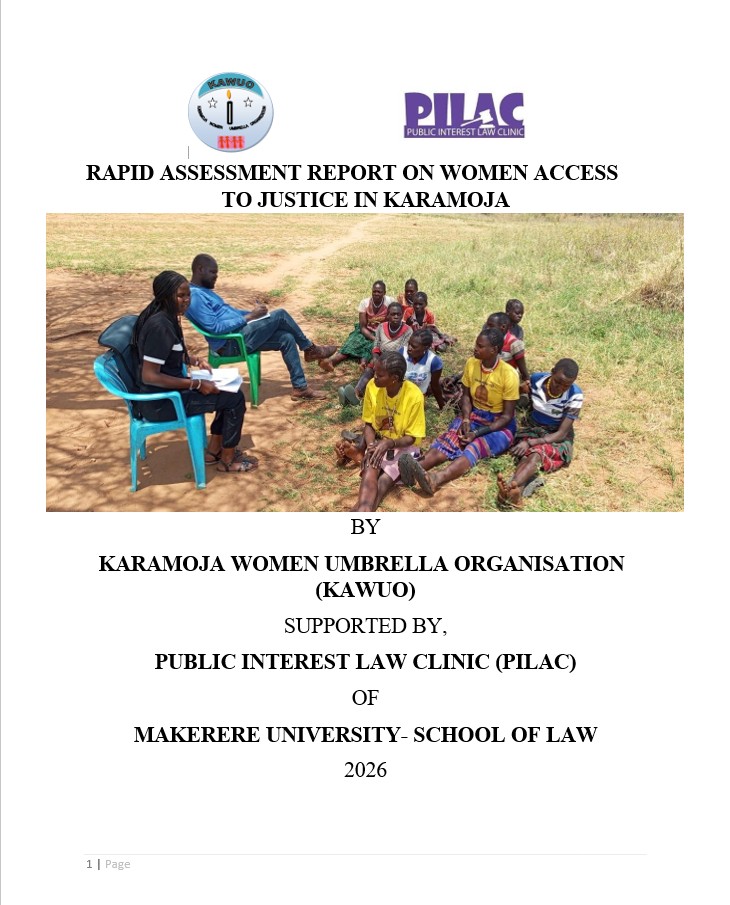
RAPID ASSESSMENT REPORT ON WOMEN ACCESS TO JUSTICE IN KARAMOJA
The rapid assessment study generated timely, context-specific evidence on women’s access to justice in relation to violence against women in Karamoja. Using a qualitative method, cross-sectional design, data was collected from 120 women across six districts through Focus Group Discussions (FGDs) and 25 Key Informant Interviews (KIIs) with justice actors, service providers, including CDOs, PSWOs, CFPU, Cultural and religious leaders, LCIs, and CBOs. The assessment examined prevalence, justice-seeking pathways, institutional responses, and barriers to accessing justice.
WOMEN's Land Rights In Karamoja Region-Uganda
This publication examines the status of women’s land rights in the Karamoja Region of Uganda, highlighting challenges, opportunities, and recommendations for improving women’s access to, ownership of, and control over land. It supports advocacy efforts aimed at promoting gender equality, inclusive land governance, and the socio-economic empowerment of women and girls.
KAWUO Branding Guidelines
The KAWUO Branding Guidelines establish the standards for the consistent use of the organization’s visual identity, including the logo, colours, typography, imagery, and communication materials. They help ensure that all KAWUO publications and outreach activities maintain a professional, recognizable, and unified brand that reflects the organization’s mission and values.
KAWUO Branding Guidelines
The KAWUO Branding Guidelines provide a comprehensive framework for maintaining a consistent and professional visual identity across all organizational communications and materials. The guidelines outline the proper use of the KAWUO logo, official colours, typography, imagery, document templates, and communication standards to ensure that every publication, digital platform, promotional material, and public engagement accurately reflects the organization’s mission, values, and identity.
These guidelines are intended for KAWUO staff, partners, consultants, volunteers, and service providers involved in producing branded content. By following these standards, KAWUO strengthens its brand recognition, enhances credibility with donors and stakeholders, and presents a unified image that promotes trust, professionalism, and accountability in all its communications.